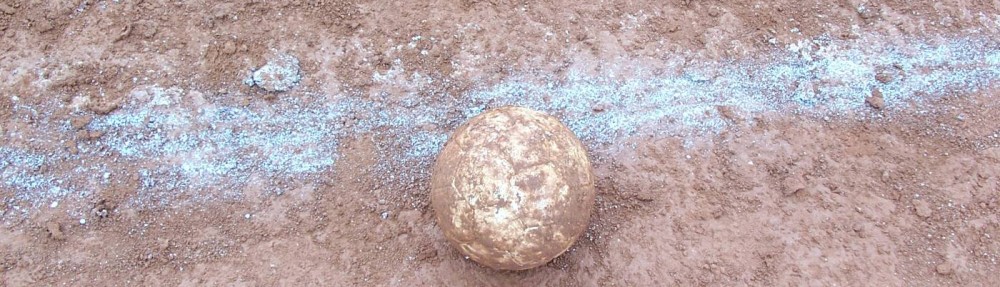
Stone Balls

Explorer Semir Osmanagic has recently returned from a visit to Mexico, in the town of Gudalahare, where he has been investigating the presence of stone balls, resembling those found across regions of Bosnia.

He found hundreds of stone balls on the Cerra Piedras Bollas hill. There was only one reference to these stone balls, reported in the National Geographic magazine in 1968. The archaologist who found and reported the stone balls could not believe that primitive Indian hands could have created the objects, which were up to 4m diametre and weighed as much as 50 tonnes.

He visited a geologist in the region who told him the local theory that the balls were thrown by a volcano, some 30km away, millions of years previously. However, most of these balls are concentrated on one hill in the region, so discounting that theory, in addition to the geometric shape of the balls.

Another local belief, that there was gold at the centre of the balls, has resulted in damage to many of the stone balls Osmanagic saw. All these balls must be the product of intelligent human beings, yet historians have all but ignored their presence – these objects have only, for example, received one small mention in National Geographic, several years before.

Little significance has been placed on their existence. On examining one of the balls in the village of Ahualulco del Mercado, Osmanavic concluded that it was created by the same methodology as that used to create stone balls in Costa Rica and Bosnia and using the same material. There is nothing in our current understanding of history that explains the presence of these stone balls.

Minority Report Medicine

Liked Doug Krell, M.D’s blog report on HealthNex about how you’d display a whole load of complex information to a clincian. Can you imagien the guys back at the UK’s Connecting for Health grappling with this one?! But maybe there’s a simple solution (I was thinking about this creatively in my post on 13 Feb) which used virtual whiteboard technology?

Wouldn’t it be great if when a patient came in, I could have all the data literally at my fingertips. Call up the x-rays, the ultrasound reports, the current EKG, order some tests and have all prior data, current data, and all interventions on a big screen right in front of my face and be able to wave my arms around and re-arrange all the information instantly just as I’d like to see it. Then be able to make a decision and document why that decision was made. One of those large computer displays like in Minority Report would be perfect.

“So how do I get one of those “decision boards” like in Minority Report? Right now our computers are so cumbersome. A small screen just doesn’t do it. Typing is time consuming. Even the mouse is less than optimal. You have to click here, close this and open that. Then it’s hard to move data and images all around like a story and put it in a format that other Doctors can understand and it takes too much time. So then what ARE the right devices for physicians for data input, data display, and documentation?

“For one thing, I believe that larger or multiple screen displays would be better for medicine. Voice recognition and transcription software needs to continue to improve. Touch-screen technology needs to be employed. If I could design software for medicine I would develop modules that would mimic the way physicians think and the way we like to see data. These modules would be like elements of a history, physical findings, test results, treatments and outcomes. Any or all elements could be combined at a particular patient encounter to support a diagnosis or treatment recommendation”.